Its Not You Its Me the Second City Reviews
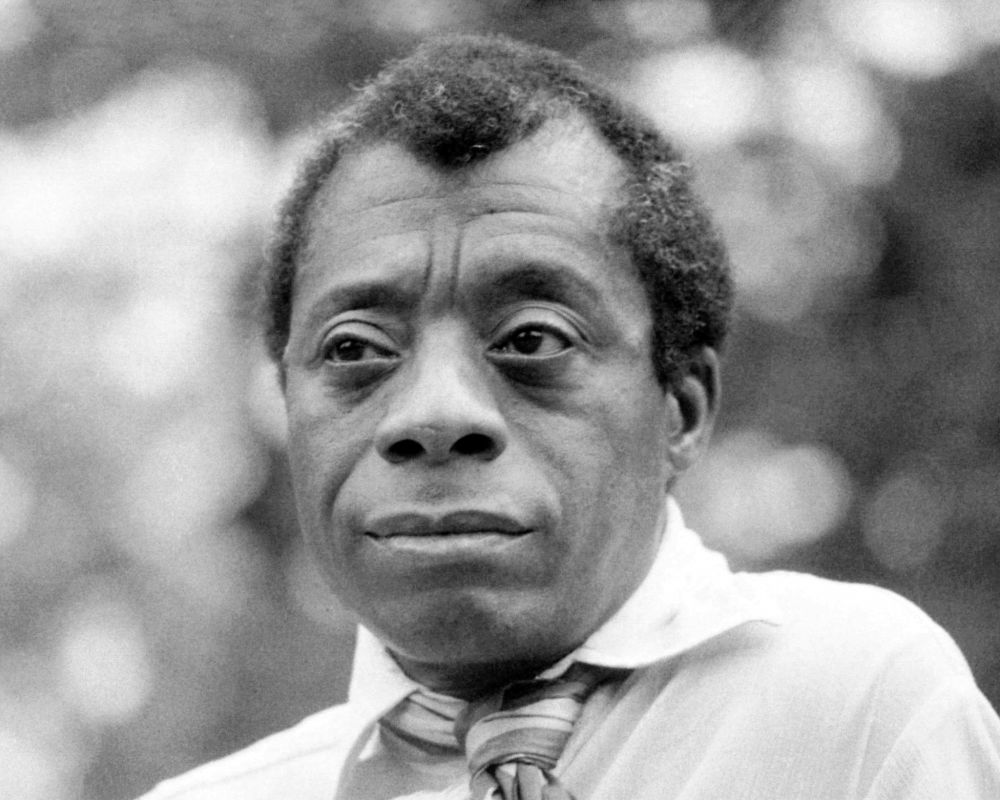 James Baldwin in Hyde Park, London. Photo by Allan Warren,The Paris Review No. 129.
This interview was conducted in the ii places beloved to James Baldwin's struggle as a writer. We met first in Paris, where he spent the first 9 years of a burgeoning career and wrote his first two novels, Go Tell It on the Mountain and Giovanni'southward Room, along with his best-known drove of essays, Notes of a Native Son. It was in Paris, he says, that he was get-go able to come to grips with his explosive human relationship with himself and America. Our second talks were held at Baldwin'southward poutres-and-rock villa in St. Paul de Vence, where he has made his home for the past ten years. We lunched on an Baronial weekend, together with seasonal guests and his secretarial assistant. Saturday, a storm raged among intolerable heat and humidity, causing Baldwin'due south minor case of arthritis to pain his writing paw (left) and wrist. Erratic power shortages caused by the tempest interrupted the tape machine by our side. During the blackouts we would discuss subjects at random or wait in silence while sipping our drinks.
Returning Sunday at Baldwin'due south invitation, the sunday was shining and we were able to lunch outdoors at a picnic table, shaded by a bower that opened onto property dotted with fruit trees and a spectacular view of the Mediterranean coastal. Baldwin'south mood had brightened considerably since the previous day, and we entered the function and written report he refers to every bit his "torture chamber."
Baldwin writes in longhand ("you achieve shorter declarative sentences") on the standard legal pad, although a large, old Adler electric sits on one cease of his desk—a rectangular oak plank with rattan chairs on either side. It is piled with writing utensils and drafts of several works-in-progress: a novel, a play, a scenario, essays on the Atlanta kid murders, these concluding compiled in The Evidence of Things Non Seen. His most recent work includes The Devil Finds Work, an attack on racial bias and fear in the moving picture industry, and a novel, Just Above My Caput, which draws on his experiences as a civil-rights activist in the 1960s.
INTERVIEWER
Would yous tell us how you came to leave the States?
JAMES BALDWIN
I was broke. I got to Paris with twoscore dollars in my pocket, but I had to get out of New York. My reflexes were tormented by the plight of other people. Reading had taken me away for long periods at a time, yet I still had to bargain with the streets and the authorities and the cold. I knew what it meant to be white and I knew what information technology meant to be a nigger, and I knew what was going to happen to me. My luck was running out. I was going to go to jail, I was going to kill somebody or be killed. My best friend had committed suicide two years earlier, jumping off the George Washington Span.
When I arrived in Paris in 1948 I didn't know a give-and-take of French. I didn't know anyone and I didn't want to know anyone. Later, when I'd encountered other Americans, I began to avert them because they had more money than I did and I didn't want to feel similar a freeloader. The forty dollars I came with, I recall, lasted me ii or iii days. Borrowing money whenever I could—oftentimes at the last infinitesimal—I moved from one hotel to another, not knowing what was going to happen to me. And so I got sick. To my surprise I wasn't thrown out of the hotel. This Corsican family, for reasons I'll never sympathise, took care of me. An erstwhile, quondam lady, a great old matriarch, nursed me back to health subsequently three months; she used old folk remedies. And she had to climb 5 flights of stairs every morning to make sure I was kept live. I went through this catamenia where I was very much alone, and wanted to be. I wasn't part of any customs until I later became the Angry Immature Human being in New York.
INTERVIEWER
Why did yous choose France?
BALDWIN
It wasn't and so much a matter of choosing France—it was a matter of getting out of America. I didn't know what was going to happen to me in France but I knew what was going to happen to me in New York. If I had stayed there, I would take gone under, like my friend on the George Washington Bridge.
INTERVIEWER
You say the urban center beat out him to death. You mean that metaphorically.
BALDWIN
Not so metaphorically. Looking for a place to live. Looking for a task. Y'all begin to doubt your judgment, you brainstorm to doubt everything. Yous become imprecise. And that's when you're beginning to go nether. Y'all've been browbeaten, and information technology's been deliberate. The whole club has decided to make y'all zippo. And they don't even know they're doing it.
INTERVIEWER
Has writing been a blazon of conservancy?
BALDWIN
I'm non so certain! I'm not certain I've escaped anything. 1 even so lives with it, in many means. It's happening all around usa, every day. It's not happening to me in the same way, because I'thousand James Baldwin; I'm not riding the subways and I'm not looking for a identify to alive. But information technology'southward withal happening. So salvation is a hard give-and-take to employ in such a context. I've been compelled in some ways by describing my circumstances to learn to live with them. It's not the same matter equally accepting them.
INTERVIEWER
Was there an instant y'all knew you were going to write, to be a writer rather than anything else?
BALDWIN
Yes. The death of my father. Until my father died I thought I could do something else. I had wanted to be a musician, thought of being a painter, thought of existence an role player. This was all earlier I was nineteen. Given the atmospheric condition in this state to be a black writer was impossible. When I was immature, people thought y'all were not so much wicked every bit sick, they gave upwards on you. My father didn't call back it was possible—he thought I'd go killed, become murdered. He said I was battling the white man's definitions, which was quite right. Only I had also learned from my begetter what he idea of the white man's definitions. He was a pious, very religious and in some ways a very beautiful man, and in some ways a terrible human. He died when his last child was born and I realized I had to make a bound—a leap. I'd been a preacher for 3 years, from historic period fourteen to seventeen. Those were iii years which probably turned me to writing.
INTERVIEWER
Were the sermons you lot delivered from the pulpit very advisedly prepared, or were they absolutely off the peak of your head?
BALDWIN
I would improvise from the texts, like a jazz musician improvises from a theme. I never wrote a sermon—I studied the texts. I've never written a speech. I tin can't read a voice communication. It's kind of give-and-take. You lot take to sense the people you're talking to. You lot have to respond to what they hear.
INTERVIEWER
Do y'all have a reader in your mind when you write?
BALDWIN
No, y'all can't have that.
INTERVIEWER
So information technology'southward quite unlike preaching?
BALDWIN
Entirely. The 2 roles are completely unattached. When you are standing in the pulpit, y'all must sound equally though you lot know what you lot're talking almost. When you're writing, y'all're trying to find out something which you don't know. The whole language of writing for me is finding out what y'all don't want to know, what you lot don't desire to observe out. Merely something forces you to anyway.
INTERVIEWER
Is that i of the reasons you decided to be a writer—to find out about yourself?
BALDWIN
I'yard not sure I decided. It was that or null, since in my ain mind I was the male parent of my family. That'south not quite the way they saw it, simply notwithstanding I was the oldest brother, and I took information technology very seriously, I had to set an example. I couldn't let anything to happen to me considering what so would happen to them? I could accept get a junkie. On the roads I traveled and the streets I ran, anything could have happened to a boy like me—in New York. Sleeping on rooftops and in the subways. Until this day I'1000 terrified of the public toilet. In any example . . . my male parent died, and I saturday downwardly and figured out what I had to exercise.
INTERVIEWER
When did yous find time to write?
BALDWIN
I was very young then. I could write and hold a few jobs. I was for a time a waiter . . . like George Orwell in Downwards and Out in Paris and London. I couldn't do it now. I worked on the Lower East Side and in what nosotros at present call Soho.
INTERVIEWER
Was in that location anyone to guide you?
BALDWIN
I remember continuing on a street corner with the black painter Beauford Delaney downwardly in the Hamlet, waiting for the low-cal to change, and he pointed down and said, "Look." I looked and all I saw was water. And he said, "Expect again," which I did, and I saw oil on the water and the urban center reflected in the puddle. It was a bully revelation to me. I can't explicate it. He taught me how to see, and how to trust what I saw. Painters have often taught writers how to run into. And once you've had that experience, you lot encounter differently.
INTERVIEWER
Practise y'all think painters would help a fledgling writer more than another writer might? Did yous read a great deal?
BALDWIN
I read everything. I read my way out of the two libraries in Harlem by the time I was thirteen. One does larn a dandy deal about writing this way. Get-go of all, yous learn how fiddling you know. It is true that the more one learns the less one knows. I'g still learning how to write. I don't know what technique is. All I know is that you take to make the reader see information technology. This I learned from Dostoyevsky, from Balzac. I'm sure that my life in France would have been very different had I non met Balzac. Fifty-fifty though I hadn't experienced information technology nonetheless, I understood something about the concierge, all the French institutions and personalities. The way that land and its society works. How to find my manner around in it, not get lost in it, and not feel rejected by it. The French gave me what I could not get in America, which was a sense of "If I tin practise information technology, I may exercise it." I won't generalize, merely in the years I grew upwardly in the U.South., I could not practise that. I'd already been divers.
INTERVIEWER
Did what you wanted to write about come easily to yous from the beginning?
BALDWIN
I had to be released from a terrible shyness—an illusion that I could hide anything from anybody.
INTERVIEWER
I would remember that anyone who could time afterward time, and without notes, address a congregation would never be shy over again.
BALDWIN
I was scared then and I'm scared at present. Communication is a two-manner street, really, it's a matter of listening to one another. During the civil-rights movement I was in the back of a church in Tallahassee and the pastor, who recognized me, called my proper noun and asked me to say a few words. I was thirty-iv and had left the pulpit seventeen years before. The moment in which I had to stand up and walk downward the aisle and stand in that pulpit was the strangest moment in my life up to that time. I managed to go through it and when I walked down from the pulpit and support the alley, a niggling quondam blackness lady in the congregation said to a friend of hers, "He's little, but he's loud!"
INTERVIEWER
What was the process whereby you were able to write?
BALDWIN
I had to go through a time of isolation in guild to come to terms with who and what I was, as distinguished from all the things I'd been told I was. Right effectually 1950 I think feeling that I'd come through something, shed a dying skin and was naked again. I wasn't, perhaps, merely I certainly felt more than at ease with myself. And so I was able to write. Throughout 1948 and 1949 I only tore up paper.
INTERVIEWER
Those years were difficult, and yet yous received four writing grants between 1945 and 1956. How much encouragement did they afford yous?
BALDWIN
Well, the first one was the nigh important in terms of morale—the Saxton Fellowship in 1945. I was xx-ane. I was launched into the publishing world, so to speak. And there was the novel, which became Go Tell It on the Mountain several years afterward.
INTERVIEWER
The Saxton was intended to aid yous finish the novel y'all were working on?
BALDWIN
It helped me finish the novel, it kept me live. The novel didn't work, just I started doing book reviews for the New Leader at 10 and twenty dollars a shot. I had to read everything and had to write all the time, and that's a great apprenticeship. The people I worked with were left-of-eye Trotskyites, Socialist Trotskyites. I was a young Socialist. That was a very nice atmosphere for me; in a sense it saved me from despair. But most of the books I reviewed were Be Kind to Niggers, Exist Kind to Jews, while America was going through i of its liberal convulsions. People suddenly discovered they had a Jewish problem, with books like Gentleman'southward Agreement, Earth and Loftier Heaven, or they discovered they had niggers, with books like Kingsblood Imperial and Quality.
Thousands of such tracts were published during those years and it seems to me I had to read every single one of them; the color of my skin made me an adept. Then, when I got to Paris, I had to belch all that, which was really the reason for my essay, "Everybody's Protestation Novel." I was convinced then—and I yet am—that those sort of books practise cipher but eternalize up an image. All of this had quite a bit to exercise with the management I took as a writer, because it seemed to me that if I took the role of a victim so I was simply reassuring the defenders of the status quo; every bit long as I was a victim they could pity me and add a few more pennies to my home-relief check. Null would change in that way, I felt, and that essay was a get-go of my finding a new vocabulary and another point of view.
INTERVIEWER
If you felt that information technology was a white human being's world, what fabricated you think that in that location was whatever point in writing? And why is writing a white human's globe?
BALDWIN
Because they ain the business organization. Well, in hindsight, what information technology came downwards to was that I would non permit myself to exist divers by other people, white or black. It was beneath me to arraign everyone for what happened to me. What happened to me was my responsibleness. I didn't want whatever pity. "Leave me alone, I'll figure it out." I was very wounded and I was very dangerous because yous go what you detest. It's what happened to my father and I didn't want information technology to happen to me. His hatred was suppressed and turned against himself. He couldn't let it out—he could just permit it out in the house with rage, and I constitute it happening to myself equally well. And after my best friend jumped off the span, I knew that I was next. Then—Paris. With forty dollars and a one-way ticket.
INTERVIEWER
Once in Paris, you spent a lot of time upstairs at the Café de Flore. Is that where Go Tell It on the Mountain and Giovanni's Room were written?
BALDWIN
A lot of Go Tell It on the Mountain had to be written at that place, between there and the Hotel Verneuil, where I stayed for a lot of the fourth dimension I was in Paris. After ten years of conveying that book effectually, I finally finished information technology in Switzerland in three months. I remember playing Bessie Smith all the time while I was in the mountains, and playing her till I fell comatose. The book was very difficult to write because I was too young when I started, seventeen; it was really most me and my father. There were things I couldn't deal with technically at first. Almost of all, I couldn't deal with me. This is where reading Henry James helped me, with his whole idea about the centre of consciousness and using a single intelligence to tell the story. He gave me the idea to make the novel happen on John'south altogether.
INTERVIEWER
Do you agree with Alberto Moravia, who said that one ought merely to write in the beginning person, because the tertiary projects a bourgeois point of view?
BALDWIN
I don't know near that. The commencement person is the most terrifying view of all. I tend to be in accord with James, who hated the start-person perspective, which the reader has no reason to trust—why should you lot need this I? How is this person real by dint of that bar blaring across the page?
INTERVIEWER
When did you first excogitate of leaving blackness characters out of Giovanni'due south Room?
BALDWIN
I suppose the simply honest reply to that is that Giovanni's Room came out of something I had to confront. I don't quite know when it came, though it bankrupt off from what later turned into Another Country. Giovanni was at a party and on his style to the guillotine. He took all the light in the book, and then the volume stopped and nobody in the book would speak to me. I thought I would seal Giovanni off into a brusk story, but it turned into Giovanni's Room. I certainly could not perchance have—not at that point in my life—handled the other great weight, the "Negro problem." The sexual-moral low-cal was a hard thing to bargain with. I could not handle both propositions in the aforementioned book. There was no room for it. I might do it differently today, but then, to have a black presence in the book at that moment, and in Paris, would take been quite beyond my powers.
INTERVIEWER
Was information technology David who showtime appeared in Giovanni's Room?
BALDWIN
It was, yes, but that novel has a curious history. I wrote four novels before I published one, before I'd even left America. I don't know what happened to them. When I came over they were in a duffel handbag, which I lost, and that's that. But the genesis of Giovanni'south Room is in America. David is the get-go person I thought of, but that'due south due to a peculiar case involving a male child named Lucien Carr, who murdered somebody. He was known to some of the people I knew—I didn't know him personally. But I was fascinated by the trial, which also involved a wealthy playboy and his wife in high-level society. From this fascination came the starting time version of Giovanni's Room, something called Ignorant Armies, a novel I never finished. The bones of Giovanni'south Room and Another Country were in that.
INTERVIEWER
Wasn't it after your first two novels, which were in many ways extremely personal, that you introduced more of the political and sociological counterpoint (evident in your essays) into Some other Land?
BALDWIN
From my point of view information technology does not quite work that way, making attempts to exist simply personal or to bring in a larger scope. No 1 knows how he writes his book. Go Tell It on the Mountain was most my relationship to my begetter and to the church, which is the aforementioned thing really. It was an endeavour to exorcise something, to observe out what happened to my father, what happened to all of us, what had happened to me—to John—and how we were to move from one place to another. Of form information technology seems rather personal, but the book is non well-nigh John, the book is non virtually me.
INTERVIEWER
"One writes out of one affair simply—1's own experience," y'all've said.
BALDWIN
Yes, and notwithstanding one's own experience is not necessarily one'due south twenty-iv-hour reality. Everything happens to you lot, which is what Whitman means when he says in his poem "Heroes," "I am the man, I suffered, I was there." It depends on what yous mean by experience.
INTERVIEWER
Nevertheless, it seems that your struggles with social injustices were kept apart equally the material for your essays, while your fiction dealt predominantly with your own past.
BALDWIN
If I wanted to survive as a writer I would somewhen have had to write a volume like Some other Country. On the other manus, short stories like "Sonny's Blues" or "Previous Status," which appeared earlier Some other Country, were highly personal and yet went further than the immediate dilemmas of the young writer struggling in the Hamlet or of Sonny in "Sonny'south Blues."
INTERVIEWER
Ralph Ellison said in his Paris Review interview that he writes "primarily not concerned with injustice, but with art," whereas one might almost observe you a sort of spokesman for blacks.
BALDWIN
I don't consider myself a spokesman—I have always thought information technology would exist rather presumptuous.
INTERVIEWER
Although you are aware of the fact that many people read and are moved by your essays, as well as your speeches and lectures . . .
BALDWIN
Let'southward get back now. Those essays actually appointment from the time I was in my early twenties, and were written for the New Leader and The Nation all those years ago. They were an attempt to get me beyond the chaos I mentioned before. I lived in Paris long enough to terminate my first novel, which was very of import for me (or I wouldn't exist here at all). What held me in Paris later—from '55 to '57—was the fact that I was going through a kind of breakup in my individual life, yet I knew I had to go dorsum to America. And I went. Once I was in the civil-rights milieu, once I'd met Martin Luther King Jr. and Malcolm Ten and Medgar Evers and all those other people, the office I had to play was confirmed. I didn't think of myself as a public speaker, or equally a spokesman, simply I knew I could get a story past the editor'south desk-bound. And once you realize that you tin do something, it would exist difficult to live with yourself if you didn't do it.
INTERVIEWER
When you were much younger, what distinctions did yous make between art and protest?
BALDWIN
I thought of them both every bit literature and still do. I don't see the contradiction which some people point out as inherent, though I tin sense what Ralph, among others, means by that. The only way I could play it, one time indeed I found myself on that road, was to presume that if I had the talent, and my talent was of import, it would but have to survive whatever life brought. I couldn't sit somewhere honing my talent to a fine edge after I had been to all those places in the S and seen those boys and girls, men and women, blackness and white, longing for change. It was incommunicable for me to driblet them a visit and then leave.
INTERVIEWER
You were in utter despair after the death of Martin Luther King Jr. Did you lot observe information technology hard to write and so, or practise you work better out of ache?
BALDWIN
No one works better out of anguish at all; that'due south an incredible literary conceit. I didn't recollect I could write at all. I didn't run across any point to it. I was injure . . . I can't fifty-fifty talk about it. I didn't know how to go along, didn't run into my fashion clear.
INTERVIEWER
How did you somewhen notice your way out of the pain?
BALDWIN
I think really through my brother, David. I was working on No Name in the Street but hadn't touched it after the bump-off. He called me and I told him "I merely can't stop this volume. I don't know what to do with it." And he came across the ocean. I was hither in St. Paul, living in Le Hameau beyond the road. I was sick, went to 4 or v hospitals. I was very lucky, because I could've gone mad. You lot see, I had left America after the funeral and gone to Istanbul. Worked—or tried to—in that location. Got sick in Istanbul, went to London, got sick in London, and I wanted to die. Collapsed. I was shipped down here, out of the American Infirmary in Paris. I'd been in the region in 1949, but I had never dreamt of coming to live in St. Paul. Once I was hither, I stayed. I didn't really accept anyplace else to go. Well, I could have gone dorsum to America, and I did, to do a Rap on Race, which helped me significantly. But principally, David came and he read No Proper name in the Street and sent it on to New York.
INTERVIEWER
In an Esquire essay, you in one case wrote that you've been "schooled in arduousness and skilled in compromise." Does that mayhap reverberate trying to go your piece of work published?
BALDWIN
No, though it has been such a stormy career. It's a terrible way to make a living. I find writing gets harder as time goes on. I'chiliad speaking of the working procedure, which demands a certain amount of energy and courage (though I dislike using the give-and-take), and a certain amount of recklessness. I don't know, I doubtfulness whether anyone—myself at to the lowest degree—knows how to talk almost writing. Perhaps I'k agape to.
INTERVIEWER
Do you see it as conception, gestation, accouchement?
BALDWIN
I don't think about it that way, no. The whole process of conception—one talks about information technology after the fact, if 1 discusses it at all. But y'all really don't empathise it. After the fact I may talk over a piece of work, yet I'g uncertain that what I do say about it after can be taken as gospel.
INTERVIEWER
One critic suggested that James Baldwin's best work was yet to come up and would be an autobiographical novel, which Only Above My Head was in office.
BALDWIN
He may have a point there. I hope, certainly, that my best work is before me. It depends on what i means by "autobiographical." I certainly have not told my story notwithstanding, I know that, though I've revealed fragments.
INTERVIEWER
Are you, or do you remain, very close to your characters?
BALDWIN
I don't know if I experience close to them, now. After a fourth dimension you find, even so, that your characters are lost to you, making it quite impossible for you to judge them. When y'all've finished a novel it ways, "The train stops here, you lot have to get off here." You lot never get the book you wanted, you lot settle for the book yous go. I've always felt that when a book ended there was something I didn't run across, and usually when I remark the discovery it'south too late to do anything about it.
INTERVIEWER
This occurs one time it has already been published?
BALDWIN
No, no, information technology happens when you are correct hither at the tabular array. The publication engagement is something else again. It's out of your easily, then. What happens here is that you realize if yous try to redo something, you may wreck everything else. But, if a volume has brought y'all from one place to another, so that you come across something you didn't meet earlier, you've arrived at another point. This then is one'south consolation, and y'all know that yous must now proceed elsewhere.
INTERVIEWER
Are at that place a lot of your characters walking around here?
BALDWIN
No, they begin walking around before you put them on paper. And later you put them on paper you don't run across them anymore. They may exist wandering around here. You might see them.
INTERVIEWER
So once yous've captured a character in your work, it is no longer a phantom?
BALDWIN
Actually, what has happened is that the character has tyrannized you lot for however long it took, and when the novel is over he or she says Ciao, thank you a lot. Pointe finale. Before Another Country, Ida talked to me for years. We get on very well at present.
INTERVIEWER
How soon after you lot conceived of Rufus, in Some other Country, did you know he was going to commit suicide, or was he modeled later your adolescent friend who jumped off the George Washington Span in New York?
BALDWIN
Oh, he was taken directly from that friend, notwithstanding, oddly enough, he was the last person to get in in the novel. I'd written the book more than once and I'd felt I'd never get it right. Ida was important, only I wasn't sure I could cope with her. Ida and Vivaldo were the outset people I was dealing with, but I couldn't find a way to make y'all empathize Ida. So Rufus came forth and the entire action made sense.
INTERVIEWER
And Richard, the rather idealistic writer?
BALDWIN
This is all far beyond my retention. Well, in that location was Vivaldo, whose name I didn't know for some time. He was called Daniel at first, and at 1 bespeak was blackness. Ida, on the other hand, was always Ida. Richard and Cass were part of the decor. From my indicate of view, at that place was nothing in the least idealistic about Richard. He was modeled on several liberal American careerists from so and now. In any instance, in gild to make the reader run across Ida, I had to give her a blood brother, who turned out to be Rufus. Information technology'southward fascinating from the point of view of styles, and of accomodations to man hurting, that it took me so long—from 1946 to 1960—to accept the fact that my friend was expressionless. From the moment Rufus was gone, I knew that if you knew what had happened to Ida, yous'd equally understand Rufus, and you'd see why Ida throughout the book was so difficult with Vivaldo and everybody else—with herself above all, considering she wasn't going to be able to live with the pain. The principal activity in the book, for me, is the journeying of Ida and Vivaldo toward some kind of coherence.
INTERVIEWER
Is at that place a big shifting of gears between writing fiction and writing nonfiction?
BALDWIN
Shifting gears, you enquire. Every form is difficult, no i is easier than some other. They all kick your ass. None of information technology comes easy.
INTERVIEWER
How many pages do you write in a day?
BALDWIN
I write at night. Afterward the twenty-four hours is over, and supper is over, I begin, and work until about iii or 4 a.grand.
INTERVIEWER
That's quite rare, isn't it, because virtually people write when they're fresh, in the morning.
BALDWIN
I start working when anybody has gone to bed. I've had to do that ever since I was young—I had to wait until the kids were asleep. And then I was working at various jobs during the day. I've ever had to write at dark. But now that I'1000 established I do it because I'm lonely at dark.
INTERVIEWER
When do yous know something is the way you want it?
BALDWIN
I practice a lot of rewriting. Information technology'south very painful. Yous know information technology's finished when you tin't do anything more to it, though it'southward never exactly the way you desire it. In fact, the hardest affair I ever wrote was that suicide scene in Some other Land. I ever knew that Rufus had to commit suicide very early, because that was the key to the book. But I kept putting information technology off. It had to practice, of class, with reliving the suicide of my friend who jumped off the bridge. Besides, it was very dangerous to practice from the technical point of view because this fundamental graphic symbol dies in the outset hundred pages, with a couple of hundred pages to become. The point upwardly to the suicide is like a long prologue, and it is the but light on Ida. Yous never become into her listen, but I had to make you see what is happening to this girl by making yous feel the blow of her blood brother'south death—the key to her relationship with everybody. She tries to brand everybody pay for it. You cannot do that, life is not like that, you only destroy yourself.
INTERVIEWER
Is that the way a volume starts for you, though? Something similar that?
BALDWIN
Probably that manner for everybody: something that irritates y'all and won't permit you go. That's the anguish of information technology. Do this book, or die. You have to go through that.
INTERVIEWER
Does it purge you lot in any style?
BALDWIN
I'g non then certain about that. For me it'southward like a journey, and the only thing yous know is that if when the volume is over, you are prepared to continue—you haven't cheated.
INTERVIEWER
What would cheating exist?
BALDWIN
Fugitive. Lying.
INTERVIEWER
So there is a coercion to get information technology out?
BALDWIN
Oh yep, to get information technology out and become it right. The word I'm using is compulsion. And it is truthful of the essay also.
INTERVIEWER
But the essay is a piffling chip simpler, isn't information technology, considering you're angry about something which you lot can put your finger on . . .
BALDWIN
An essay is not simpler, though it may seem so. An essay is essentially an argument. The writer's signal of view in an essay is ever absolutely clear. The author is trying to make the readers run across something, trying to convince them of something. In a novel or a play you're trying to prove them something. The risks, in whatsoever case, are exactly the same.
INTERVIEWER
What are your first drafts like?
BALDWIN
They are overwritten. Most of the rewrite, then, is cleaning. Don't describe it, show information technology. That's what I try to teach all young writers—take it out! Don't describe a royal sunset, brand me run into that information technology is purple.
INTERVIEWER
Equally your experience about writing accrues, what would you say increases with noesis?
BALDWIN
Yous learn how little you know. It becomes much more than difficult considering the hardest thing in the world is simplicity. And the virtually fearful thing, too. It becomes more difficult because you have to strip yourself of all your disguises, some of which yous didn't know you had. You want to write a sentence as clean as a os. That is the goal.
INTERVIEWER
Do you mind what people say about your writing?
BALDWIN
Ultimately not. I minded information technology when I was younger. You intendance about the people you care about, what they say. Yous care nigh the reviews so that somebody volition read the book. So, those things are of import, merely not of ultimate importance.
INTERVIEWER
The attitudes y'all found in America which fabricated you go to France—are they still with us, are they exactly the same?
BALDWIN
I always knew I would have to come back. If I were twenty-iv at present, I don't know if and where I would become. I don't know if I would go to France, I might go to Africa. You lot must recall when I was twenty-four there was actually no Africa to become to, except Liberia. I thought of going to Israel, but I never did, and I was right well-nigh that. Now, though, a kid now . . . well, you see, something has happened which no one has really noticed, only it's very important: Europe is no longer a frame of reference, a standard-bearer, the archetype model for literature and for civilization. It's not the measuring stick. There are other standards in the globe. It's a fascinating time to be living. In that location'south a whole wide world which isn't at present as it was when I was younger. When I was a kid the world was white, for all intents and purposes, and now it is struggling to remain white—a very different thing.
INTERVIEWER
It's frequently been noted that yous are a main of minor characters. How do you answer to that?
BALDWIN
Well, small characters are the subtext, illustrations of whatever it is you lot're trying to convey. I was always struck by the minor characters in Dostoyevsky and Dickens. The minor characters take a sure liberty which the major ones don't. They can make comments, they can move, all the same they haven't got the same weight, or intensity.
INTERVIEWER
Yous mean to say their deportment are less accountable?
BALDWIN
Oh no, if you lot fuck upward a small-scale character you fuck up a major one. They are more than a part of the decor—a kind of Greek chorus. They carry the tension in a much more explicit way than the majors.
INTERVIEWER
Excuse me for asking, but might your female parent be standing behind you lot while y'all're writing; is she perhaps behind many of your characters?
BALDWIN
I wouldn't think and then, merely to tell you the truth, I wouldn't know. I've got 5 sisters. And in a funny mode, there have been many women in my life, so it wouldn't be my mother.
INTERVIEWER
Accept you been through analysis?
BALDWIN
God no, never got "adapted."
INTERVIEWER
Both you and William Styron (intentionally or not) write about victims and victimization. Styron has said he has never felt similar a victim. Have you?
BALDWIN
Well, I reject to. Perhaps the turning signal in i'due south life is realizing that to be treated like a victim is not necessarily to become i.
INTERVIEWER
Practise you believe in a community of writers? Is that of any interest to yous?
BALDWIN
No. I've never seen 1 in any case . . . and I don't call up whatever writer ever has.
INTERVIEWER
But weren't William Styron and Richard Wright, say, important to you in formulating your viewpoints?
BALDWIN
Richard was very important to me. He was much older. He was very nice to me. He helped me with my first novel, really. That was 1944–45. I just knocked on his door out in Brooklyn! I introduced myself, and of grade he'd no idea who I was. There were no essays then, no fiction—this was 1944. I adored him. I loved him. Nosotros were very unlike each other, as writers, probably as people too. And every bit I grew older, that became more and more apparent. And after that was Paris.
INTERVIEWER
And Styron?
BALDWIN
Well, as I was maxim, Neb is a friend of mine who happens to be a author.
INTERVIEWER
Did you accept a position on his book nigh Nat Turner?
BALDWIN
I did. My position, though, is that I will not tell another writer what to write. If you lot don't like their alternative, write yours. I admired him for confronting it, and the effect. It brought in the whole enormity of the issue of history versus fiction, fiction versus history, and which is which . . . He writes out of reasons similar to mine: about something which hurt him and frightened him. When I was working on Another Country and Bill was working on Nat Turner, I stayed in his guest firm for five months. His hours and mine are very different. I was going to bed at dawn, Pecker was just coming up to his study to go to work; his hours going on every bit mine went off. Nosotros saw each other at suppertime.
INTERVIEWER
What kind of conversations would you concord?
BALDWIN
Nosotros never spoke about our work, or very rarely. It was a wonderful time in my life, but not at all literary. We sang songs, drank a little too much, and on occasion chatted with the people who were dropping in to see u.s.a.. We had a sure mutual inheritance in terms of the music.
INTERVIEWER
What sort of music are yous hearing while in the immediate process of writing? Do you experience annihilation physical or emotional?
BALDWIN
No. I'm very common cold—cold probably isn't the word I want: controlled. Writing for me must be a very controlled do, formed by passions and hopes. That is the only reason you get through it, otherwise y'all may as well do something else. The act of writing itself is cold.
INTERVIEWER
I'm going to presage my own question. Nigh of the novelists I've spoken to merits they read exceedingly fewer gimmicky novels, only discover themselves drawn to plays, history, memoirs, biographies, and poetry. I believe this is true for yous as well.
BALDWIN
In my case it is due to the fact that I'1000 always doing some kind of research. And aye, I read many plays and a lot of poetry as a kind of apprenticeship. You are fascinated, I am fascinated past a certain optic—a process of seeing things. Reading Emily Dickinson, for instance, and others who are quite far removed from one'southward ostensible daily concerns, or obligations. They are freer, for that moment, than you lot are partly because they are expressionless. They may likewise be a source of forcefulness. Contemporary novels are part of a universe in which you accept a certain role and a certain responsibility. And, of course, an unavoidable curiosity.
INTERVIEWER
You lot read contemporary novels out of a sense of responsibility?
BALDWIN
In a way. At any rate, few novelists interest me—which has nothing to do with their values. I find almost of them also remote for me. The earth of John Updike, for instance, does not impinge on my world. On the other hand, the world of John Cheever did engage me. Obviously, I'grand not making a very significant judgment about Updike. Information technology's entirely subjective, what I'm saying. In the main, the concerns of most white Americans (to use that phrase) are boring, and terribly, terribly self-centered. In the worst sense. Everything is contingent, of form, on what you take yourself to exist.
INTERVIEWER
Are you suggesting they are less concerned, somehow, with social injustice?
BALDWIN
No, no, you lot meet, I don't want to make that kind of dichotomy. I'yard non asking that anybody get on sentry lines or take positions. That is entirely a private matter. What I'm proverb has to do with the concept of the cocky, and the nature of self-indulgence which seems to me to exist terribly strangling, and then limited information technology finally becomes sterile.
INTERVIEWER
And yet in your own writing yous deal with personal experiences quite often.
BALDWIN
Yeah, only—and here I'grand in trouble with the language once again—it depends upon how yous conceive of yourself. Information technology revolves, surely, around the multiplicity of your connections. Obviously yous can only deal with your life and piece of work from the vantage point of your self. At that place isn't whatsoever other vantage indicate, there is no other point of view. I tin't say about whatsoever of my characters that they are utter fictions. I do have a sense of what nagged my attending where and when; even in the dimmest sense I know how a character impinged on me in reality, in what nosotros call reality, the daily world. And then, of course, imagination has something to practise with it. But it has got to be triggered by something, it cannot be triggered past itself.
INTERVIEWER
What is information technology about Emily Dickinson that moves you?
BALDWIN
Her use of language, certainly. Her solitude, equally well, and the fashion of that solitude. In that location is something very moving and in the all-time sense funny. She isn't solemn. If y'all really desire to know something nigh solitude, become famous. That is the turn of the screw. That solitude is practically insurmountable. Years ago I thought to exist famous would be a kind of x-24-hour interval wonder, and then I could go right back to life equally usual. Only people care for you differently before you realize information technology. You see information technology in the wonder and the worry of your intimates. On the other side of that is a cracking responsibility.
INTERVIEWER
Is one's past cluttered, equally a historic writer?
BALDWIN
At that place are many witnesses to my past, people who've disappeared, people who are dead, whom I loved. But I don't experience there are whatsoever ghosts, any regrets. I don't feel that kind of melancholy at all. No nostalgia. Everything is always around and before you. Novels that haven't worked, loves, struggles. And notwithstanding it all gives you lot something of immeasurable power.
INTERVIEWER
This brings us to your concern with reality as existence history, with seeing the present shaded by everything which occurred in a person's past. James Baldwin has always been bound by his past, and his futurity. At forty, yous said you lot felt much older than that.
BALDWIN
That is i of those things a person says at forty, at twoscore peculiarly. Information technology was a great shock to me, forty. And I did feel much older than that. Responding to history, I think a person is in sight of his or her expiry effectually the historic period of xl. Y'all see it coming. Yous are not in sight of your death at 30, less and so at 20-five. You are struck past the fact of your mortality, that it is unlikely you'll live another forty years. So time alters you, really condign either an enemy or a friend.
INTERVIEWER
Y'all seem very troubled—but non by death?
BALDWIN
Yes, truthful, simply not at all by decease. I'm troubled over getting my piece of work done and over all the things I've not learned. It's useless to exist troubled by death, considering then, of form, yous can't live at all.
INTERVIEWER
"Essentially, America has not changed that much," y'all told the New York Times when Just To a higher place My Head was being published. Accept y'all?
BALDWIN
In some means I've inverse precisely because America has not. I've been forced to alter in some ways. I had a certain expectation for my land years agone, which I know I don't accept at present.
INTERVIEWER
Yes, before 1968, you said, "I love America."
BALDWIN
Long before then. I however do, though that feeling has changed in the face of it. I recall that it is a spiritual disaster to pretend that ane doesn't love i'southward land. You may disapprove of it, you may be forced to leave information technology, y'all may live your whole life as a battle, all the same I don't think you can escape it. There isn't any other place to go—you don't pull up your roots and put them down someplace else. At least not in a single lifetime, or, if you practise, you'll be aware of precisely what it means, knowing that your existent roots are always elsewhere. If yous try to pretend you don't run into the firsthand reality that formed you I think you'll go bullheaded.
INTERVIEWER
Every bit a writer, are at that place whatsoever particular battles you feel you've won?
BALDWIN
The battle of condign a writer at all! "I'thousand going to be a cracking author when I abound up," I used to tell my mother when I was a little boy. And I'm still going to be a nifty author when I grow up.
INTERVIEWER
What practice you tell younger writers who come to yous with the usual desperate question: How do I become a writer?
BALDWIN
Write. Detect a way to keep alive and write. In that location is nothing else to say. If you lot are going to be a writer there is nil I tin say to stop you; if yous're non going to exist a author nothing I tin say will help you. What you lot really need at the get-go is somebody to allow you know that the effort is real.
INTERVIEWER
Can you discern talent in someone?
BALDWIN
Talent is insignificant. I know a lot of talented ruins. Beyond talent prevarication all the usual words: field of study, love, luck, merely, most of all, endurance.
INTERVIEWER
Would you advise that a young writer from a minority consecrate himself to that minority, or is his offset obligation his own self-realization as a author?
BALDWIN
Your self and your people are indistinguishable from each other, really, in spite of the quarrels you lot may accept, and your people are all people.
INTERVIEWER
Wasn't Giovanni's Room partially an attempt to break downwardly these divisions, pointing out that David could be white, black, or yellow?
BALDWIN
Certainly, for in terms of what happened to him, none of that mattered at all.
INTERVIEWER
Withal, later on, notably in the case of Rufus and Another Country, 1'south race becomes essential to your story.
BALDWIN
Important in that particular novel, aye, but Another Country is called that because it is trying to convey the reality of that country. The story would be different if information technology were in France, or even in England.
INTERVIEWER
What is your nowadays relationship with people like Ralph Ellison, Imamu Baraka (LeRoi Jones) or Eldridge Cleaver?
BALDWIN
I never had a human relationship with Cleaver. I was in difficulties because of Cleaver, which I didn't want to talk near then, and don't wish to discuss now. My existent difficulty with Cleaver, sadly, was visited on me by the kids who were following him, while he was calling me a faggot and the remainder of it. I would come to a town to speak, Cleveland, let's say, and he would've been continuing on the very aforementioned stage a couple of days before. I had to effort to undo the damage I considered he was doing. I was handicapped with Soul on Ice, considering what I might have said in those years about Eldridge would have been taken as an answer to his attack on me. So I never answered it, and I'k not answering information technology now. Cleaver reminded me of an one-time Baptist government minister I used to work with when I was in the pulpit. I never trusted him at all. As for Baraka, he and I have had a stormy time too, simply we're very expert friends at present.
INTERVIEWER
Do you read each other's piece of work?
BALDWIN
Yep—at least I read his. And as for Ralph, I oasis't seen him in many years.
INTERVIEWER
You haven't corresponded at all?
BALDWIN
No. I gather Ralph did not like what he considered I was doing to myself on the civil-rights route. And so, we haven't seen each other.
INTERVIEWER
If you were both to run into over lunch tomorrow, what might you talk nearly?
BALDWIN
I'd love to meet him for lunch tomorrow, and share a bottle of bourbon, and probably talk about the last twenty years we haven't seen each other. I have nothing against him in any case. And I love his great book. We disagreed about tactics, I suppose. But I had to get through the civil-rights motion and I don't regret it at all. And those people trusted me. There was something very beautiful about that period, something life-giving for me to be there, to march, to be a role of a sit-in, to see it through my ain eyes.
INTERVIEWER
Exercise you think that at present blacks and whites can write about each other, honestly and convincingly?
BALDWIN
Yes, though I take no overwhelming evidence in hand. But I remember of the bear on of spokespersons similar Toni Morrison and other younger writers. I believe what i has to do as a black American is to take white history, or history as written by whites, and merits it all—including Shakespeare.
INTERVIEWER
"What other people write virtually me is irrelevant," you lot in one case wrote in Essence. Was that meant to go unqualified; do you not chronicle to criticism in whatsoever mode?
BALDWIN
Information technology is never entirely true that you don't requite a shit what others say about you, but you must throw it out of your mind. I went through a very trying period, afterward all, where on one side of town I was an Uncle Tom and on the other the Angry Young Man. It could make one's head spin, the number of labels that have been attached to me. And information technology was inevitably painful, and surprising, and indeed, bewildering. I exercise intendance what certain people call up near me.
INTERVIEWER
Merely non literary critics?
BALDWIN
Literary critics cannot be 1's business. Ideally, withal, what a critic can do is indicate where you've been excessive or unclear. As far every bit any sort of public opinion is a question, I would say that one cannot perchance react to any of it. Things may be said which hurt, and you don't similar it, merely what are you to do? Write a White Paper, or a Blackness Newspaper, defending yourself? You can't do that.
INTERVIEWER
You accept often left your home in St. Paul, returning to America and going on the road. Do you experience comfortable as a speaker?
BALDWIN
I take never felt comfortable as a speaker, no.
INTERVIEWER
You feel more at ease backside the typewriter?
BALDWIN
Well, certainly, although I used to exist a preacher, which helps on the road.
INTERVIEWER
Tin you talk a little more about your relationship to Richard Wright, under whose aegis you received your outset writing grant?
BALDWIN
Every bit I said earlier, I but knocked on his door in New York. I was nineteen. And he was very nice. The just trouble was I didn't drink in those years. He drank bourbon. Now, I'm going to relieve you the trouble of request me nearly writers and alcohol: I don't know any writers who don't drink. Everybody I've been close to drinks. Simply yous don't drink while you lot're working. Information technology'south funny, because it is all a reflex, like lighting a cigarette. Your drink is made and and then yous go off to some other place. When yous finally get back to the drink it'due south mainly water. And the cigarette has gone out. Talking about Richard and our early hostile flow, which I thought was ridiculously blown out of proportion, I should say that when I idea I was dealing with Richard, I was in fact thinking of Harriet Beecher Stowe and Uncle Tom's Cabin. Richard's Native Son was the but contemporary representation there was of a black person in America. One of the reasons I wrote what I did near the volume is a technical objection, which I uphold today. I could not accept the performance of the lawyer at the cease of the book. I was very explicit most that. I remember it was simply absurd to talk virtually this monster created past the American public, and and so look the public to save it! Birthday, I found it too simpleminded. Insofar as the American public creates a monster, they are not most to recognize it. You create a monster and destroy information technology. It is part of the American way of life, if yous like. I reserve, in whatever case, the utmost respect for Richard, especially in low-cal of his posthumous work, which I believe is his greatest novel, Lawd Today. Look it up.
INTERVIEWER
Is there any resistance today to black writers in publishing houses?
BALDWIN
There is an enormous resistance, though it differs from Wright'south time. When I was immature, the joke was "How many niggers you got at your plantation?" Or, more snidely, "How many niggers you got at your publishing house?" And some had i, most had none. That's not true now.
INTERVIEWER
How does information technology strike you that in many circles James Baldwin is known as a prophetic writer?
BALDWIN
I don't try to be prophetic, as I don't sit downward to write literature. Information technology is simply this: a writer has to accept all the risks of putting down what he sees. No one tin can tell him about that. No i can control that reality. It reminds me of something Pablo Picasso was supposed to have said to Gertrude Stein while he was painting her portrait. Gertrude said, "I don't look like that." And Picasso replied, "Yous volition." And he was right.
pridemorefrob1971.blogspot.com
Source: https://www.theparisreview.org/interviews/2994/the-art-of-fiction-no-78-james-baldwin
0 Response to "Its Not You Its Me the Second City Reviews"
Post a Comment